Vestibular Therapy Winnipeg
Vestibular Therapy In Winnipeg
Vestibular Therapy refers to treatment of conditions involving the balance organs of the inner ear. Impairments in the Vestibular system can cause symptoms of Vertigo, Dizziness and Imbalance, often dramatically affect a person’s quality of life.
Research supports strong evidence proving Vestibular Therapy as an effective treatment in managing conditions such as Benign Positional Paroxysmal Vertigo (BPPV), Vestibular Neuritis/Labrynthitis, Vestibular Loss/Hypofunction, Post-Surgical Dizziness, Post-Concussion Syndrome, PPPD, Cervicogenic Dizziness and more.
The vestibular system includes the parts of the inner ear and brain that help control balance and eye movements, and tells your brain where your head is moving in space. A problem within the vestibular system can cause the following sensations:
- Dizziness
- Vertigo (spinning or falling sensation)
- Fullness in the head
- Feeling “off kilter”
- Light-headedness
- Blurred vision
- Nausea
- Floating or swaying sensation
- Swaying sensation
- Imbalance
Vestibular Physiotherapy Pricing:
$170 for Assessment and $125 for follow ups
Common Vestibular Conditions Include:
- Benign Positional Paroxysmal Vertigo (BPPV)
- Vestibular Neuritis/Labrynthitis
- Ototoxicity
- Perilymphatic Fistula
- Acoustic Neuroma
- Mal de Debarquement Syndrome
- Meniere’s Disease
- Canal Dehiscence
- Post-Concussion Syndrome
- Persistent Postural Perceptual Dizziness (PPPD)
- Vestibular Migraine

BPPV Treatment
Benign Positional Paroxysmal Vertigo is a condition of the inner ear in which small crystals (otoconia) that are normally located in the saccule and utricle of the inner ear become displaced. These crystals make their way into the semicircular canals where they don’t belong. When a person moves their head in certain directions, gravity will move these crystals in the canal, stimulating the nerves and causing a sensation of vertigo. The vertigo can vary from mild to extremely intense. Common triggers are turning over in bed, looking up high, lying flat and bending forward.
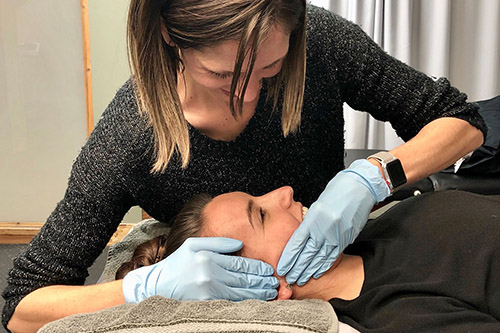
BPPV is treated with a canalith repositioning maneuver. The physiotherapist will take you through a detailed assessment using infrared goggles to determine which ear and which canal is involved. Based on this information the therapist will move your head through a series of positions to guide the crystals back into place, where they will be reabsorbed. Common maneuvers used to treat BPPV are the Epley, Semont, BBQ roll, Half Sommersault, Guffoni and others. Based on your presentation your therapist will determine which maneuver is most likely to reposition the otoconia. You will be sent home with sleep positioning instructions, and sometimes with an exercise to do on your own. BPPV can generally be successfully treated within 1-3 sessions.
Vestibular Rehabilitation
A problem within the vestibular system can result in sensations of dizziness, imbalance, blurred vision and fatigue as your brain is not getting all the information it needs to do its job. Vestibular impairments can be temporary, or damage to these nerves can also be permanent. The good news is that your brain is very good at adjusting to an impairment and can learn to re-organize connections. In science we call this concept “neuroplasticity”.
The goal of Vestibular Rehabilitation is to train various systems and expose your body to different stimulus that will encourage this “recalibration”. Vestibular rehab exercises will be custom tailored to your unique situation and often include the vision system (gaze stability exercises), balance exercises, and habituation exercises.


Concussion Management
A concussion is defined as a traumatic brain injury induced by biomechanical forces. Concussion typically results in functional disturbances of brain function rather than structural injury – meaning we may not see physical damage on imaging of the brain, however its function is temporarily impaired. Concussion research has been vastly expanding in recent years.
There is still much we don’t understand about concussion. Individuals with post concussion syndrome sometimes present similarly to a person with vestibular hypofunction, possibly due to an impairment in the way the brain is processing vestibular information. Using the principles of vestibular rehabilitation to treat post-concussion syndrome is often helpful in reducing symptoms. In addition to vestibular rehabilitation your therapist will assess and treat the neck, as injury and spasm in the upper cervical spine can also contribute to dizziness. Your therapist will also spend a lot of time on education to help guide a safe return to your normal activity level.
Concussion is a complex problem and your physiotherapist will work in communication with your physician to best manage your care. Involvement of other health professionals in areas of mental health or occupational therapy may also assist in your recovery.
Balance Assessments
Balance problems don’t always come from the inner ear. Vestibular impairments are a common cause, but factors such as stiff joints, weak muscles, slow reflexes, poor vision, decreased sensation in the feet, Stroke, MS, Parkinson’s Disease and more can all have detrimental effects on balance.
Having impaired balance can dramatically affect your quality of life. When you’re fearful of falling you will generally be less active physically and socially, which can lead to poor physical and mental health. There is almost always something you can do to improve your balance.
At Physiotherapy ‘n Balance we will take you through a complete balance assessment to determine the factors that may be contributing to your imbalance. From there we will help you with home exercise, educate you on strategies to improve your safety, and recommend or fit a gait aid to you accordingly if needed. Take the first step to getting your confidence back today!